

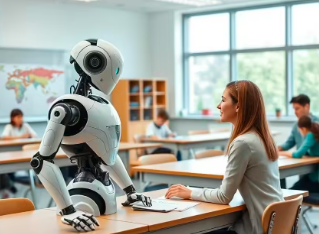
Walk into any modern university library or scroll through an online learning platform, and you’ll instantly feel the pulse of digital transformation. Screens flicker with interactive diagrams, chatbots provide instant support, and adaptive algorithms promise to personalize learning like never before. There’s no denying that technology is revolutionizing how students access information and practice new skills. But in this rush toward automation, a crucial question often gets lost in the digital noise: Is faster and more convenient truly better for genuine learning and intellectual growth?
The simple answer is: not always. While AI can process data and offer practice problems at lightning speed, it cannot truly mentor a student. Automated systems are tools—powerful and useful tools, certainly—but they are not guides. They cannot replace the profound, transformative impact of dedicated human-centric mentorship.
This deep connection between mentor and mentee, characterized by empathy, shared experience, and critical discourse, remains the undisputed gold standard in education for one simple reason: it addresses the student as a whole person, not just a set of data points. For deep, meaningful understanding and navigating complex academic challenges, many students ultimately seek reliable assignment help from real experts who can provide nuanced guidance and foster genuine intellectual curiosity.
The Limits of Algorithmic Guidance
Let’s be clear about what AI in education actually is. It is essentially sophisticated pattern recognition. It excels at identifying knowledge gaps based on quiz performance and recommending corresponding practice material. It’s highly effective for drill-and-kill exercises, rote memorization tasks, and answering foundational questions quickly.
But education, at its core, is not simply about regurgitating facts; it’s about synthesis, critical thinking, ethical consideration, and applying abstract concepts to real-world complexities. This is precisely where algorithms stumble and where human mentorship thrives.
An AI chatbot can tell you the definition of cognitive dissonance. A human mentor, however, can help you explore how this psychological principle might have influenced historic events like the Cuban Missile Crisis or explain how it manifests in the subtle, often unseen, ethical biases embedded within facial recognition algorithms. The latter requires messy, nuanced discussion, not a multiple-choice question or a pre-programmed response. Automation optimizes for efficiency; human mentorship optimizes for insight.
This limitation becomes especially glaring when tackling advanced, technically complex subjects. Take, for instance, a student grappling with complex machine learning models. A digital platform might efficiently guide them through the syntax for building a neural network in Python. However, it can’t easily explain the crucial intuition behind choosing specific hyperparameters or help them understand the real-world implications when that model makes a flawed, biased prediction in a critical healthcare setting.
Students struggling with these conceptual hurdles often look for specialized resources, such as specific machine learning homework help, where they can connect with professionals who can explain the nuanced “why” behind the code, fostering a much deeper conceptual understanding.
The Power of Professional & Life Experience
The foundation of genuine mentorship isn’t just knowledge; it’s wisdom gained through experience. A great mentor isn’t just an encyclopedia; they are an expert practitioner who has walked the path the student is now on. They know the common pitfalls, the “hidden curriculum” required for success in a field, and, crucially, how to translate abstract concepts into tangible, professional practice.
This experiential knowledge is inherently non-automated. It’s built through years of research, industry practice, successes, and—perhaps most importantly—failures. When a student feels overwhelmed by a challenging project or discouraged by a setback, a human mentor can offer a personal anecdote: “I struggled with this exact concept when I was your age; here’s how I finally broke through,” or “That research topic sounds interesting, but in the professional world, we generally approach that problem by focusing on this variable instead.”
This advice isn’t generated from a database; it’s an act of professional and personal connection. It provides context, reassurance, and strategic insight that no algorithm can ever possess. It connects the classroom to the career path, showing students not just what to learn, but how that learning shapes their professional identity and equips them for real-world impact.
Empathy: The Critical Catalyst for Genuine Understanding
Education is not just an intellectual journey; it’s a deeply emotional one, fraught with anxiety, imposter syndrome, and periods of intense frustration. This emotional dimension is where automated learning systems fundamentally break down. Algorithms cannot read a student’s non-verbal cues. They cannot detect the subtle shift in tone that signals confusion or the silent struggle of a student who is on the verge of giving up.
Human mentors, however, are wired for empathy. A perceptive mentor can tell when a student is intellectually tired, conceptually lost, or just needs to be reassured that they belong in the program. That moment in a mentoring session where the student finally understands a complex idea? It’s not just about a correct answer popping up on a screen; it’s visible in the release of tension, the look of relief, and the newly energized demeanor.
Mentorship builds a safe, supportive container for vulnerability, which is crucial for deep learning. Students need to know it’s okay to be confused, to ask the same question multiple times, and to fail. By validating their struggles, human mentors foster resilience and a growth mindset. They don’t just teach the material; they actively teach the student how to learn and navigate the inevitable intellectual and emotional challenges that come with academic growth. An algorithm can never truly offer the encouragement, understanding, or psychological safety that a committed human mentor provides.
Fostering Critical Inquiry & Thought Leadership
Ultimately, the goal of education isn’t just to produce proficient test-takers or efficient employees; it is to cultivate independent thinkers and responsible future leaders. AI systems are designed for efficient compliance—to get you to the one “correct” answer as defined by their programming. Human mentorship, at its best, is designed for critical critique and intellectual challenge.
A mentor shouldn’t just confirm a student’s ideas; they should actively poke holes in them, forcing the student to defend their reasoning, consider alternative perspectives, and confront their own biases. This intellectual sparring is where critical thinking is forged. It cannot be automated because it requires spontaneous, unstructured discourse based on a deep understanding of the student’s unique intellectual trajectory.
By modeling rigorous inquiry, mentors teach students how to ask better questions, evaluate evidence, and construct robust, ethical arguments—skills that are infinitely more valuable (and less likely to be automated away) than rote memorization or basic coding proficiency. In an increasingly automated world, the ability to think independently, ethically, and strategically is the ultimate competitive advantage, and it is a capacity nurtured almost exclusively through authentic human-centric mentorship. Technology can certainly accelerate the process of learning, but only a human mentor can cultivate the intellectual virtues that define a true scholar and leader.
Conclusion
While automation offers undeniable speed and accessibility, it cannot replicate the soul of true education: the human connection. Algorithms process data, but mentors process potential. By providing emotional support, sharing real-world wisdom, and challenging students to think critically, human-centric mentorship ensures that learning remains a transformative journey rather than a mechanical task. As we move further into a digital future, balancing innovative tools with personalized guidance will remain the ultimate strategy for academic and professional excellence.